Mud Tubes on Your Foundation: What They Mean and What an Inspection Looks For
A pencil-wide line of dried dirt on the foundation is worth stopping for, and worth photographing before you touch it.
October 26, 2026 · 4 min read
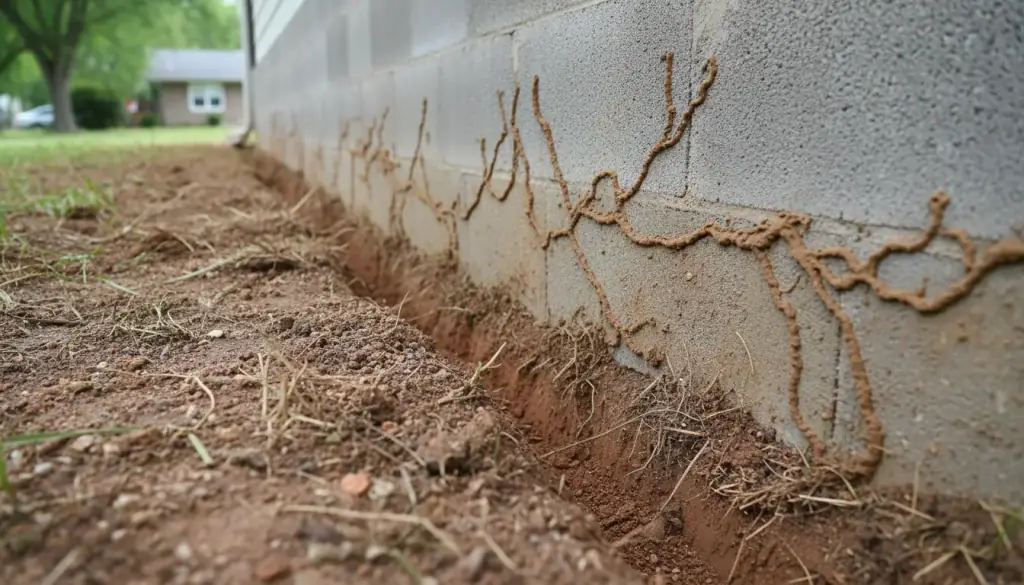
You're pulling pine straw away from the brick, or edging along the garage, and you notice a thin, dirt-colored line running up the foundation. It's about as wide as a pencil and looks like somebody dragged a muddy finger up the wall. In the red clay around Henderson, Oxford and Louisburg, that line is worth stopping for.
What a mud tube actually is
Subterranean termites live in the soil and can't stand open, dry air. To get from the ground to the wood in your house, they build tunnels out of soil, bits of wood and their own saliva. A mud tube is one of those tunnels. It lets them cross a bare block or brick face without being exposed, and it keeps them damp while they work.
Finding one doesn't mean the house is coming down. It does mean termites have found a route from the ground to your structure, and the tube is only the visible part of something mostly hidden. The colony itself usually lives in the soil, not in the tube.
Active, old or abandoned?
Homeowners often ask whether they should break a tube open to check. A trained eye can usually tell more by looking, but here's the general idea. A tube that has been abandoned tends to be dry and crumbly, and it may be empty. That doesn't mean the problem went away, because termites often build new tubes close by. A tube that looks fresh, feels damp, or gets rebuilt after you knock it down points to current activity.
Whatever you decide, take a photo before you touch anything, and tell the inspector exactly where you found it. That one detail saves a lot of searching.
What a termite inspection looks for
A real inspection is slower than most people expect. Whitco's termite work starts with inspecting the property for signs and problem areas, and after treatment the company offers yearly inspections to keep control going. Here's what the person with the flashlight is hunting for:
- Mud tubes on the foundation wall, on piers in the crawl space, and around pipes that come up through the floor or slab.
- Wood that sounds hollow when you tap it with a screwdriver handle, or that crumbles and looks layered when probed.
- Discarded wings, usually in small piles on window sills or near doors, left behind after a swarm.
- Wood touching soil: steps, deck posts, fence boards tied into the house, firewood stacked against the siding.
- Moisture: leaking spigots, downspouts that dump against the foundation, damp crawl space soil, and ground that slopes toward the house instead of away.
- Garage walls and the spots where a porch or slab meets the house, since those joints give termites easy cover.
None of those signs is proof by itself. Together they tell the inspector where to look harder and what to recommend.
Why hollow block gets special attention
Plenty of homes in this part of North Carolina sit on concrete block, and block is hollow inside. Whitco's own pages call a hollow block foundation a frequently exploited entry point for termites, because they can travel up through the cores where nobody can see them. That's why, on a block foundation, the company drills into the block and treats it, and treats the garage and crawl space too, rather than only working the soil outside the wall.
What treatment looks like
If the inspection finds activity, you'll be offered treatment options to eradicate the colony. Whitco names Termidor as its favorite termite treatment option and describes it as a time-tested termiticide. Your technician can walk you through what goes where on your particular house, and you're welcome to ask about every step before you agree to anything.
Inspections matter even when nothing is wrong. One customer on Whitco's reviews page, Susan Crews, wrote that along with quarterly service, Whitco “has completed termite inspections on the home we sold and the home we remodeled.” Buying, selling and remodeling are all moments when a second set of eyes on the wood is well worth having.
What you can do before anyone arrives
- Photograph the tubes, wings or damaged wood, with something in the frame for scale.
- Resist the urge to spray them. Disturbing termites can push them to tunnel somewhere you can't see.
- Pull mulch and pine straw back so the top of the foundation stays visible.
- Point downspouts and spigots away from the wall.
If you've found a tube, a swarm, or you just want a trained set of eyes on a house, the termite control page at /services/termite-control explains how Whitco approaches it. Estimates are free with no obligation. Call (252) 492-2818 Monday through Friday, 8 to 5, and you'll talk to a live person who can set up the inspection.
Whitco Bug Warriors, (252) 492-2818
Call (252) 492-2818More articles
A Wet Crawl Space and Termites Are Usually the Same Problem
Termites and rot fungi want the same thing from your house: damp wood. Fix one without the other and you've only solved half.
One-Time, Monthly or Quarterly: Choosing a Pest Control Plan
The right plan depends on the problem you have today and the one you want to avoid next year.